Why Business Owners Need
Passive Income
As a business owner, you already do what few others can — build, lead, and grow something from the ground up. You’ve taken risks, created jobs, and generated real income. But if you’re like many high-performing entrepreneurs, your wealth is still tied up in one place: your business.
And that’s a risk.
Your time is limited. Your energy is finite. And while your business may thrive today, markets shift, regulations evolve, and personal priorities change. That’s why more business owners are turning to passive income — not to retire early, but to gain leverage, diversify their wealth, and create options.
You Don’t Have to Do It All
Passive income isn’t about slowing down. It’s about protecting what you’ve built. It’s about earning without extra hours, growing without more stress, and investing without becoming a full-time expert.
You don’t need more work. You need your money to work harder and smarter for you.
Why Real Estate? Why Healthcare?
Among the many passive income strategies, commercial real estate stands out for its combination of income stability, tax advantages, and tangible value. And within real estate, healthcare properties offer a unique edge: long-term tenants, resilient demand, and alignment with macro trends like population aging and medical decentralization.
It’s a sector that rewards stability — not speculation.
This Guide Is for You
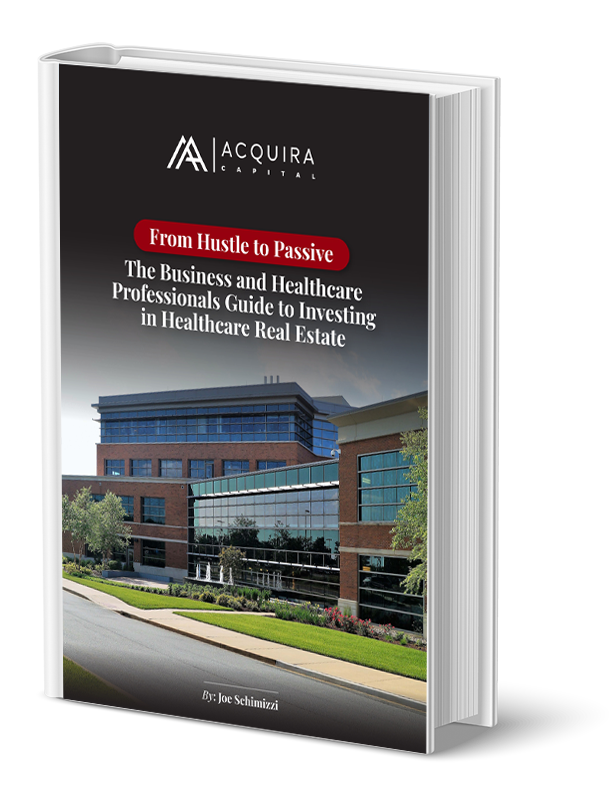
This eBook is designed specifically for business owners who want to step into passive investing without getting overwhelmed. You’ll learn why healthcare real estate is one of the most powerful vehicles for long-term wealth, what to look for in a fund, and how Acquira Capital helps make the process simple, secure, and strategic.
Let’s explore how to turn your hard-earned income into lasting financial freedom — without adding another job to your plate.
The Case for Real Estate: Stability, Tax Benefits, and Wealth Preservation
When it comes to protecting and growing wealth, real estate has long been a cornerstone of smart investing — and for good reason. Unlike volatile stocks or intangible assets, commercial real estate offers something business owners value deeply: stability, control, and long-term value.
Stability in a Shifting Economy
Markets rise and fall. Businesses face competition, labor costs, and economic shifts. But real estate — especially in sectors like healthcare — often moves on a steadier path. With long-term leases and essential service tenants, healthcare real estate continues to generate income even when other markets dip.
For investors, that means consistent cash flow, lower volatility, and less sleepless nights.
Tax Advantages Built for Business Owners
Real estate is one of the most tax-advantaged asset classes available. As a business owner, you already understand the power of strategic deductions — real estate amplifies that.
From depreciation (which creates paper losses even when properties are cash-flowing) to 1031 exchanges, bonus depreciation, and pass-through deductions, real estate offers sophisticated ways to reduce taxable income and keep more of what you earn.
And when you invest passively through a private fund, you still benefit from these advantages — without having to manage properties or tax paperwork yourself.
Wealth Preservation You Can See and Touch
Unlike stocks or crypto, real estate is tangible. It doesn’t vanish overnight. It appreciates over time. And it often performs best when held long term — exactly the horizon that smart investors prefer.
For business owners nearing transition, planning for succession, or simply wanting to protect the wealth they’ve built, real estate offers a way to diversify out of their business and into something equally strategic — but far less demanding.
What is Healthcare Real Estate
And Why It Matters
You’ve probably walked into healthcare real estate hundreds of times — but never thought of it as an investment opportunity.
Healthcare real estate refers to medical office buildings (MOBs), outpatient clinics, surgical centers, dental offices, urgent care centers, and specialty care facilities. These properties are leased by healthcare providers who deliver essential, non-elective services — and that makes them fundamentally different from other commercial real estate categories.
Why It’s More Than Just “Medical Space”
Healthcare real estate isn’t just about doctor’s offices. It’s about serving a growing, durable need: the delivery of healthcare in community-based settings.
As hospitals shift toward outpatient care to reduce costs and improve access, demand for smaller, specialized medical spaces is rising. Combine that with the aging U.S. population and increased demand for preventative care, and you get a powerful tailwind behind this asset class.
In short: this isn’t a trend. It’s a long-term structural shift.
Tenants That Stick Around
Healthcare providers rarely move. Why? Because relocating a practice means changing licensing, notifying patients, reconfiguring equipment, and navigating regulatory approvals. That means longer lease terms, lower vacancy rates, and stickier tenants — exactly what you want as a passive investor.
Additionally, many leases are structured as triple-net (NNN) leases, meaning the tenant pays for property taxes, insurance, and maintenance. This results in more predictable income and lower landlord responsibilities.
A Hedge Against Uncertainty
During economic downturns, people may cut back on retail spending or delay business purchases — but they won’t skip medical appointments or prescription refills. Healthcare real estate offers a level of recession resistance that’s hard to match.
This makes it especially attractive for investors looking to protect principal, generate steady cash flow, and hold long-term.
You don’t need to be a healthcare expert to invest in this space; you just need access, insight, and the right team. That’s where private equity funds like Acquira Capital come in.
Next, we’ll walk you through how passive investing works and how to go from interest to ownership without adding another job to your life.
The Passive Investor’s Path: From Interest to Investment
You’re interested in passive income, you like the idea of healthcare real estate — but how do you actually get started?
The truth is, most successful business owners don’t have the time to underwrite deals, interview property managers, or learn the intricacies of zoning and tenant improvements. And the good news is: you don’t have to.
Passive investing is about leveraging the right team so you can put your capital to work without putting your time at risk. Here’s how that journey typically unfolds
Step 1: Understand Your Investment Goals
Are you focused on monthly income? Long-term equity? Tax efficiency? Or a mix?
Understanding your objectives helps determine the type of real estate investment that fits your strategy. A well-structured private equity fund should offer a clear balance of yield, appreciation, and tax benefits — and show you exactly how it plans to deliver them.
Step 2: Learn the Basics — Without the Overwhelm
You don’t need to become a real estate expert, but you should know the fundamentals:
- What is the fund’s target IRR and cash-on-cash return?
- How does it generate income?
- Who manages the properties?
- What are the risks — and how are they mitigated?
- A trusted investment sponsor should answer these questions clearly and directly, without jargon.
Step 3: Choose a Sponsor You Trust
This is the most important decision you’ll make. The right sponsor:
- Has a proven track record in the asset class
- Communicates regularly and transparently
- Aligns incentives with investors
- Offers a structure that prioritizes your interests
At Acquira Capital, we designed our fund specifically for busy business owners. We handle the acquisition, operations, and reporting — so you can focus on your business while your investment works in the background.
Step 4: Invest, Review, and Repeat
Once you’re comfortable, your first investment should be simple and seamless. From there, your passive income journey becomes repeatable with regular distributions, tax benefits, and a portfolio that grows without draining your time.
In the next section, we’ll show you how Acquira Capital makes that path even easier — with a fund built for people like you.
How Acquira Capital Makes It Easy
You’ve already put in the hard work — building a business, managing teams, navigating growth. The last thing you need is another complex project disguised as an investment.
At Acquira Capital, our mission is simple
To make passive healthcare real estate investing easy, transparent, and rewarding for business owners like you.
Here’s how we do it:
We Specialize in What Matters: Healthcare Real Estate
Our focus isn’t scattered. We invest exclusively in medical office buildings and healthcare-related assets — because that’s where we see long-term, recession-resistant value.
We understand the nuances of this space, from tenant underwriting to regulatory trends. That allows us to identify opportunities that others miss, and protect your capital with smart, data-driven decisions.
Hands-Off for You. All-Hands from Us.
When you invest with Acquira Capital, you’re not just writing a check — you’re plugging into an experienced, vertically integrated team:
- Acquira Realty Holdings acts as the operating sponsor, managing acquisitions and strategy.
- Acquira Property Management ensures each asset is maintained, optimized, and tenant-focused.
- Our fund structure is designed for efficiency, clarity, and consistent reporting.
You invest — we handle the rest.
Built for Busy Professionals
We designed our process for people who value time as much as returns:
- Simple onboarding and accreditation process
- Quarterly updates with real performance data
- Clear communication with no industry jargon
- Access to your investment dashboard 24/7
Our upcoming Acquira Strategic Healthcare Real Estate Fund is a 506(c) fund, giving accredited investors access to a diversified portfolio of healthcare properties without needing to find or manage a single deal.
We’re Investors, Too
We don’t just raise capital. We invest alongside our partners. That means our interests are aligned with yours, and we’re personally committed to the performance of every asset we manage.
If you’re looking for a smart, simple way to start building passive income through real estate — without adding stress or complexity — we’d love to be your partner.
Next, we’ll show you how to evaluate a healthcare real estate fund — and what separates a good one from a great one.
What to Look for in a Healthcare
Real Estate Fund
Investing in healthcare real estate can offer steady income, tax advantages, and long-term growth — but not all funds are created equal. The right fund will protect your capital, generate real returns, and provide peace of mind. The wrong one will do the opposite.
So how do you tell the difference?
Below are the key criteria every business owner should consider before investing in a healthcare real estate fund.
1. Sector Focus and Specialization
Look for a fund that focuses exclusively or primarily on healthcare. The medical sector has unique dynamics — tenant retention, regulatory requirements, specialized buildouts — and it takes an experienced operator to manage them well.
Tip: Avoid funds that lump healthcare into a general real estate strategy. You want a team that lives and breathes this space.
2. Track Record and Experience
Ask:
- How many deals has the sponsor completed?
- What is their current Assets Under Management (AUM)?
- Have they operated successfully through different market cycles?
Experience doesn’t just reduce risk — it helps the sponsor uncover opportunities others might miss.
3. Investor Alignment
The sponsor should invest alongside you. This ensures that your goals capital preservation, yield, and growth are shared. Look for language like “co-investment” or “skin in the game.”
Also, review how profits are split. Are the fees and promotion structures fair? Are investors prioritized in the return waterfall?
4. Transparency and Communication
You should know exactly how your money is being used — and how your investment is performing. Look for a sponsor that offers:
- Regular performance updates
- Clear financial reporting
- Access to a dashboard or investor portal
You’re passive — but you shouldn’t be in the dark.
5. Asset Selection Strategy
Does the fund pursue stabilized assets, value-add deals, or development? Each has a different risk/return profile. The best sponsors can articulate their investment thesis clearly, showing how they underwrite deals and mitigate risks.
Choosing the right fund is about asking the right questions, and trusting your instincts. In the next section, we’ll address some of the most common concerns busy entrepreneurs have about passive investing, so you can move forward with confidence.
Frequently Asked Questions
You’ve made it this far because you’re curious, motivated, and serious about building lasting wealth. But if you’re like most investors we speak to, you still have a few questions before taking the next step. Here are five of the most common questions we hear from business owners exploring healthcare real estate through Acquira Capital.
We know that stepping into a new investment opportunity comes with questions — especially when your time is limited and your capital is hard-earned. Here are five of the most common questions we hear from business owners exploring healthcare real estate through Acquira Capital.
1. What exactly am I investing in?
You’re investing in income-producing healthcare real estate — like medical office buildings, outpatient centers, and surgical clinics — through a professionally managed private fund. As a Limited Partner, you’re a passive investor. We manage the acquisitions, operations, and reporting while you receive updates and distributions without lifting a finger.
2. What kind of returns can I expect?
Returns vary depending on the property and investment strategy, but our fund targets 15–20% internal rates of return (IRR) on stabilized acquisitions, with upside potential on value-add opportunities. Most deals include a preferred return, meaning investors receive a baseline return before profits are shared.
3. How and when do I get paid?
Distributions are typically paid monthly or quarterly, depending on the asset. Payments are made via direct deposit, and you’ll receive detailed reporting on performance through your investor dashboard. Your capital is usually held for 3 to 7 years, with potential for early return via refinance strategies.
4. What are the tax benefits?
Investing in real estate can offer significant tax advantages. You’ll receive a K-1 statement annually, which includes your share of deductions from expenses, depreciation, and other benefits. Many investors are able to defer or reduce taxable income thanks to these built-in efficiencies — all while generating passive cash flow.
5. How is this different from other investment options?
Unlike volatile markets or high-maintenance real estate, healthcare real estate offers stable cash flow, long-term tenants, and recession resistance. And unlike blind pool funds, you’ll know exactly which properties you’re investing in. It’s a hands-off, strategic path to long-term wealth — built for business owners who don’t want another job.
Have more questions? That’s a good thing. Schedule a call with our team and let’s talk through your goals, your concerns, and whether this is the right fit for your portfolio. We’re here to make healthcare real estate simple, secure, and aligned with your financial future. Continue reading to learn how to get started with Acquira Capital!
Getting Started with Acquira Capital
You didn’t build a business by sitting on the sidelines. You saw opportunity, took calculated risks, and committed to a long-term vision. Passive investing in healthcare real estate is no different — it’s about positioning your capital where it can grow, protect, and support your wealth beyond the day-to-day demands of business ownership.
At Acquira Capital, we’re here to make that transition simple.
We understand that time is your most valuable asset. That’s why we’ve designed our investment process to be clear, efficient, and fully aligned with the needs of high-performing entrepreneurs.
What Happens Next?
If what you’ve read in this guide resonates, here’s how to take the next step:
-
Schedule a Discovery Call
Speak directly with our team to discuss your goals, answer your questions, and see if our fund is a fit for your portfolio.
-
Review the Investment Offering
We’ll provide a comprehensive breakdown of our upcoming healthcare real estate fund including target returns, asset types, risk profile, and structure.
-
Complete Accreditation and Invest
As a 506(c) offering, our fund is open to accredited investors. We’ll guide you through a simple, secure onboarding process.
-
Start Building Passive Income
Once invested, you’ll receive regular updates, distributions (as applicable), and full transparency into your portfolio — all without lifting a finger.
This Isn’t Just an Investment. It’s a Shift.
- It’s a shift from active income to true financial leverage.
- From being the operator, to becoming the owner.
- From doing everything, to letting your capital do the work.
Our team at Acquira Capital is committed to being the partner you trust to guide that shift.Because you didn’t build your success just to stay busy — you built it to create freedom.
Let’s make that freedom real.